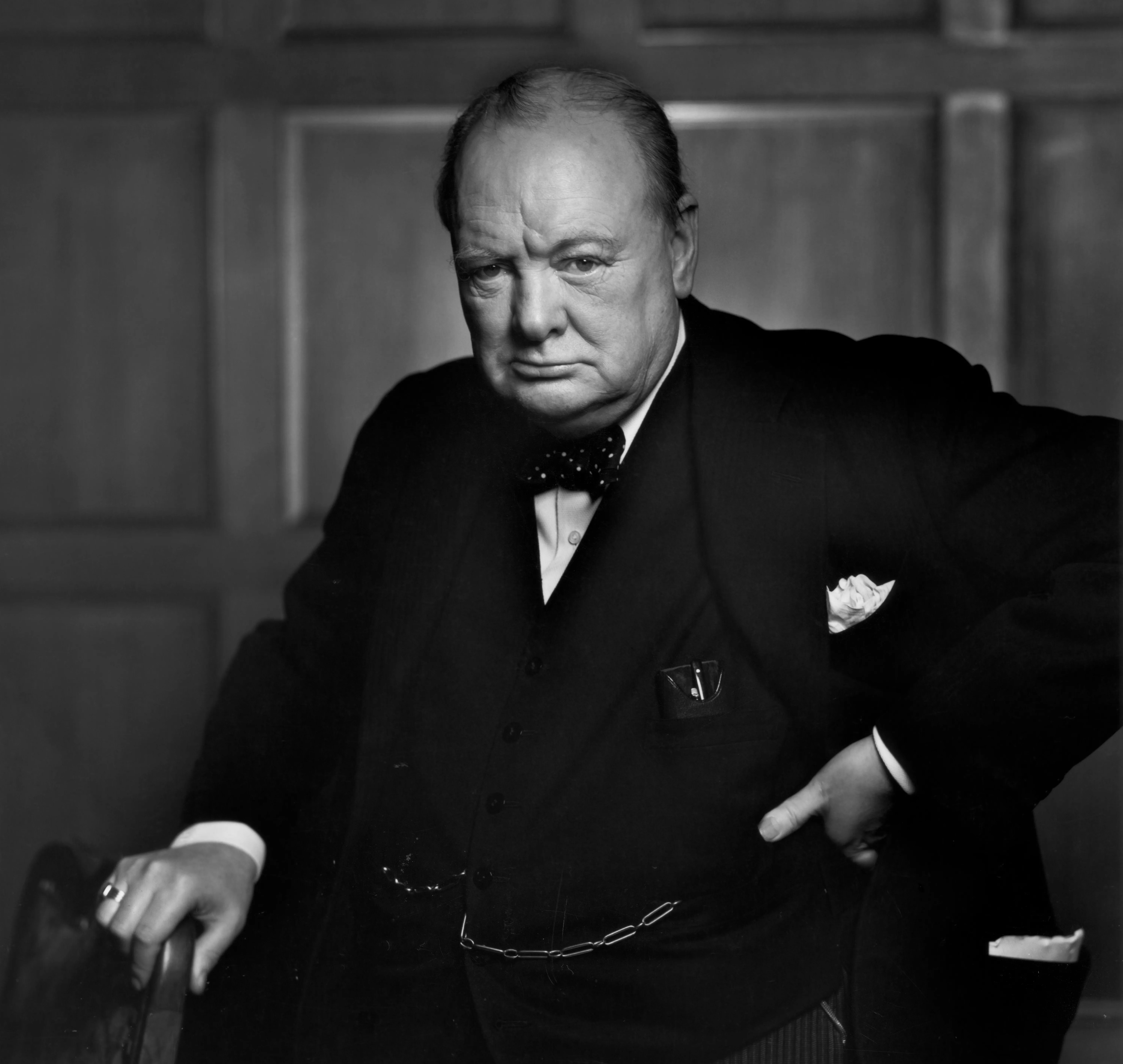
Winston Churchill
Summary
Details
- Over the course of his life, he had a prodigious output: 10 million words, 40 books, 500 paintings, 2300 speeches
- He wrote his first book soon after seeing combat at 21.
- By 26 he was elected into office.
- He held position of minister of defence, lord of the admiralty, chancellor of the exchequer, and prime minister
- He was a man of routine, even on christmas:
- bath at 8.
- 2hrs reading
- noon: say hello to his wife
- writing
- stop for lunch early afternoon, get dressed
- go for a walk, feed his swans and fish
- sit on the porch and think
- 3pm nap for 2 hours
- family time
- second bath
- dinner and drinks at 8pm
- last writing sprint.
- apart from painting, he also cultivated bricklaying a hobby
Quotes
- Conservation of energy. Never stand up when you can sit down, and never sit down when you can lie down. - Winston Churchill
- Test the door - Winston Churchill
- Have an ambitious plan - Winston Churchill
- Short speech needs preparation - Winston Churchill
- First principles and simple actions - Winston Churchill
- Never give in. never never never never - Winston Churchill
- Those whose work is their pleasure need a break - Winston Churchill
- I have nothing to offer but blood toil tears and sweat - Winston Churchill
- I wanted freedom, then I wanted order. Then I realized order is freedom - Winston Churchill
References
Quotes
He first saw combat at age twenty-one, and wrote his first bestselling book about it not long after. By twenty-six, he’d been elected to public office and would serve in government for the next six and half decades. He’d write some ten million words and over forty books, paint more than five hundred paintings, and give some twenty-three hundred speeches in the course of his time on this planet. In between all that, he managed to hold the positions of minister of defense, first lord of the admiralty, chancellor of the exchequer, and of course, prime minister of Britain, where he helped save the world from the Nazi menace. Then, to top it off, he spent his twilight years fighting the totalitarian communist menace
Immediately, Churchill replied, “Conservation of energy. Never stand up when you can sit down, and never sit down when you can lie down.”
Churchill conserved his energy so that he never shirked from a task, or backed down from a challenge. So that, for all this work and pushing, he never burned himself out or snuffed out the spark of joy that made life worth living. (Indeed, in addition to the importance of hard work, Johnson said the other four lessons from Churchill’s remarkable life were to aim high; to never allow mistakes or criticism to get you down; to waste no energy on grudges, duplicity, or infighting; and to make room for joy.) Even during the war, Churchill never lost his sense of humor, never lost sight of what was beautiful in the world, and never became jaded or cynical.
As a writer, he was gaspingly productive. While holding political office, Churchill managed to publish seven books between 1898 and the end of World War I alone. How did he do it? How did he manage to pull so much out of himself? The simple answer: physical routine. Each morning, Churchill got up around eight and took his first bath, which he entered at 98 degrees and had cranked up to 104 while he sat (and occasionally somersaulted) in the water. Freshly bathed, he would spend the next two hours reading. Then he responded to his daily mail, mostly pertaining to his political duties. Around noon he’d stop in to say hello to his wife for the first time— believing all his life that the secret to a happy marriage was that spouses should not see each other before noon. Then he tackled whatever writing project he was working on—likely an article or a speech or a book. By early afternoon he would be writing at a fantastic clip and then abruptly stop for lunch (which he would finally dress for). After lunch, he would go for a walk around Chartwell, his estate in the English countryside, feeding his swans and fish—to him the most important and enjoyable part of the day. Then he would sit on the porch and take in the air, thinking and musing. For inspiration and serenity he might recite poetry to himself. At 3 p.m., it was time for a two-hour nap. After the nap, it was family time and then a second bath before a late, seated and formal dinner (after 8 p.m.). After dinner and drinks, one more writing sprint before bed.
It was a routine he would stick to even on Christmas.
In typical Churchillian fashion, he chose an unexpected form of leisure: bricklaying. Taught the craft by two employees at Chartwell, he immediately fell in love with the slow, methodical process of mixing mortar, troweling, and stacking bricks. Unlike his other professions, writing and politics, bricklaying didn’t wear down his body, it invigorated him. Churchill could lay as many as ninety bricks an hour. As he wrote to the prime minister in 1927, “I have had a delightful month building a cottage and dictating a book: 200 bricks and 2000 words a day.” (He also spent several hours a day on his ministerial duties.) A friend observed how good it was for Churchill to get down on the ground and interact with the earth. This was also precious time he spent with his youngest daughter, Sarah, who dutifully carried the bricks for her father as his cute and well-loved apprentice
How necessary this turned out to be, because in 1929 his stunning political career suddenly came to what appeared to be an ignominious end. Driven from political life, Churchill spent a decade in pseudo-exile at Chartwell, while Neville Chamberlain and a generation of British politicians appeased the growing threat of Fascism in Europe.
Life does that to us. It kicks our ass. Everything we work for can be taken away. All our powers can be rendered impotent in a moment. What follows this is not just an issue of spirit or the mind, it’s a real physical question: What do you do with your time? How do you handle the stress of the whiplash?
Marcus Aurelius’s answer was that in these situations one must “love the discipline you know and let it support you.” In 1915, reeling from the failure of the Gallipoli campaign, Churchill wrote of feeling like a “sea-beast fished up from the depths, or a diver too suddenly hoisted, my veins threatened to burst from the fall in pressure. I had great anxiety and no means of relieving it; I had vehement convictions and small power to give effect to them.” It was then that he picked up painting, and in 1929, experiencing a similar loss in cabin pressure, he returned to his discipline and his hobbies for relief and for reflection.
Instead, he fought. He stood alone. As he said to the House of Commons:
Even though large tracts of Europe and many old and famous States have fallen or may fall into the grip of the Gestapo and all the odious apparatus of Nazi rule, we shall not flag or fail. We shall go on to the end, we shall fight in France, we shall fight on the seas and oceans, we shall fight with growing confidence and growing strength in the air, we shall defend our Island, whatever the cost may be, we shall fight on the beaches, we shall fight on the landing grounds, we shall fight in the fields and in the streets, we shall fight in the hills; we shall never surrender, and even if, which I do not for a moment believe, this Island or alarge part of it were subjugated and starving, then our Empire beyond the seas, armed and guarded by the British Fleet, would carry on the struggle, until, in God’s good time, the New World, with all its power and might, steps forth to the rescue and the liberation of the old.
In all he would paint some 550 paintings in his lifetime, 145 of them after the war.