Archiemedes
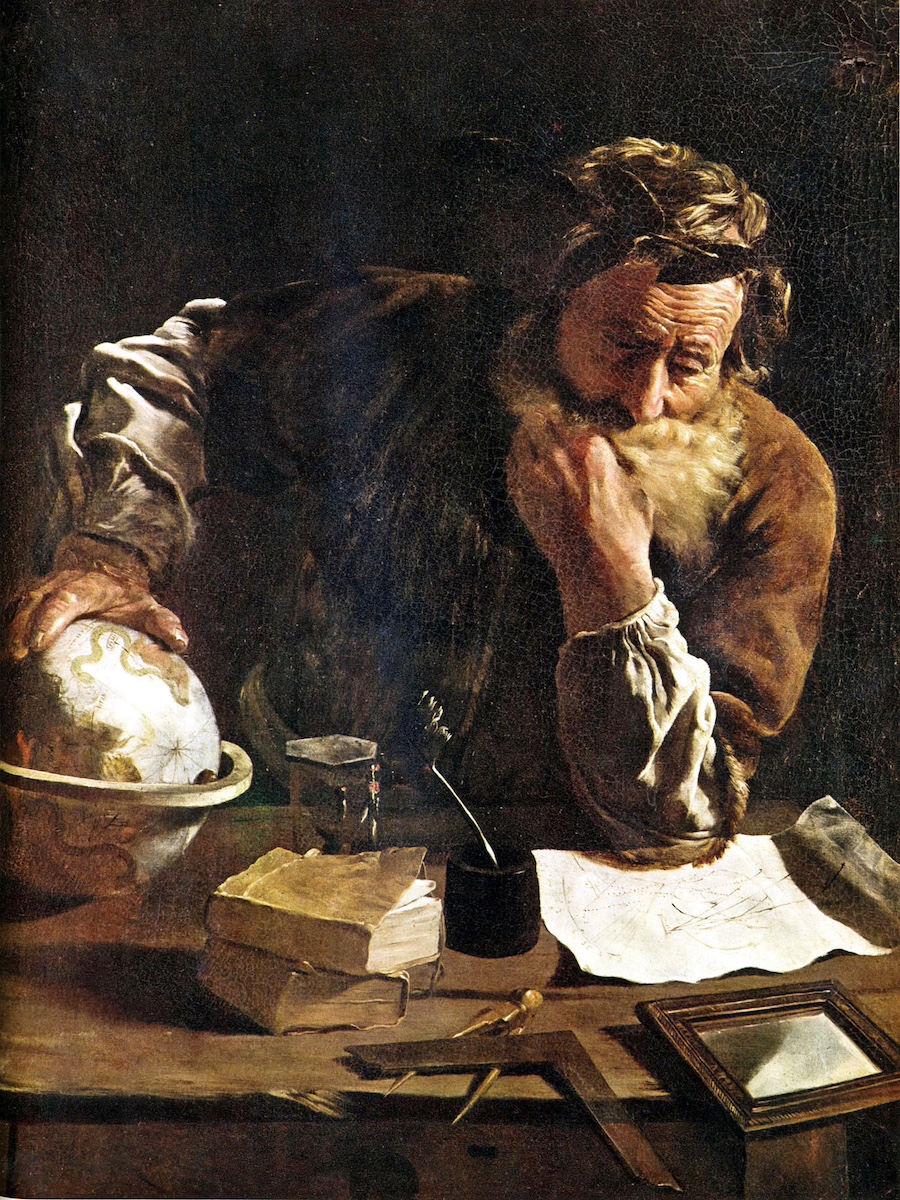
Summary
- 287 - 212 BCE
- Ancient Greek scientist, mathematician, engineer, physicist and astronomer
- considered one of the greatest mathematicians of all time
Details
- Worked on what would become calculus, area of a circle, surface area and volume of a sphere, area of an ellipse, pi and much more
- invented machines such as the screw pump, pulley systems and various war machines
- He is said to have died when the Romans captured Syracuse. Archimedes was sat on the ground drawing circles and working on a problem. A Roman soldier demanded that Archimedes follow him, and when he refused since his calculation was not yet complete, cut him down with his sword.
- His last words were said to be 'do not disturb my circles' (though this may be legend)
- The widely recounted story of Archimedes was solving the problem of knowing whether the kings crown was made of gold or mixed with silver, without actually melting the crown.
- He figured out the problem when he was having a bath and noticed the bath water rising when he entered the bath. He realised that an item placed in water would displace its volume and thus the volume of the item could be calculated. He was so excited he ran through the streets naked shouting 'Eureka!' (Greek 'I have found it!')
References
Quotes
Perhaps, given more time, Archimedes might have begun to see the lure of
the infinite and of zero. But the sand reckoner was destined to meet his fate while reckoning in the sand. The Romans were too powerful for the Syracusans. Taking advantage of a poorly manned watchtower and an easy-to-climb wall, the Romans managed to get some soldiers inside the city. As soon as they realized that Romans were inside the walls of the city, the Syracusans, wild with fear, could not mount a defense. The Romans poured through the city, but Archimedes was deaf to the panic around him. He sat on the ground, drawing circles in the sand, trying to prove a theorem. A Roman soldier saw thebedraggled 75-year-old and demanded that Archimedes follow him. Archimedes refused, since his mathematical proof was not yet finished. The enraged soldier cut him down. Thus died the greatest mind in the ancient world, slaughtered needlessly by the Romans.
Killing Archimedes was one of the biggest Roman contributions to
mathematics. The Roman era lasted for about seven centuries. In all that time there were no significant mathematical developments. History marched on: Christianity swept through Europe, the Roman Empire fell, the Library at Alexandria burned, and the Dark Ages began. It would be another seven centuries before zero reappeared in the West. In the meantime two monks created a calendar without zero, damning us to eternal confusion
Plutarch (45–119 AD) wrote in his Parallel Lives that Archimedes was related to King Hiero II, the ruler of Syracuse.[26|26] He also provides at least two accounts on how Archimedes died after the city was taken. According to the most popular account, Archimedes was contemplating a mathematical diagram when the city was captured. A Roman soldier commanded him to come and meet Marcellus, but he declined, saying that he had to finish working on the problem. This enraged the soldier, who killed Archimedes with his sword. Another story has Archimedes carrying mathematical instruments before being killed because a soldier thought they were valuable items. Marcellus was reportedly angered by Archimedes' death, as he considered him a valuable scientific asset (he called Archimedes "a geometrical Briareus") and had ordered that he should not be harmed.[27|27][28|28]
The last words attributed to Archimedes are "Do not disturb my circles" (Latin, "Noli turbare circulos meos"; Katharevousa Greek, "μὴ μου τοὺς κύκλους τάραττε"), a reference to the mathematical drawing that he was supposedly studying when disturbed by the Roman soldier. There is no reliable evidence that Archimedes uttered these words and they do not appear in Plutarch's account. A similar quotation is found in the work of Valerius Maximus (fl. 30 AD), who wrote in Memorable Doings and Sayings, "... sed protecto manibus puluere 'noli' inquit, 'obsecro, istum disturbare'" ("... but protecting the dust with his hands, said 'I beg of you, do not disturb this'").[20|20]